
Pi Network was trending at the time. Many people were mining it, and some had already decided what one Pi should be worth. The most extraordinary figure I kept seeing was the so-called Global Consensus Value, or GCV, of $314,159 per Pi. I found it difficult to understand how people expected buyers to pay that amount simply because members of a community had agreed on it.
When Pi’s Open Network launched in February 2025, trading told a different story. The price briefly reached about $2.99 within its first week, far below the GCV figure. Some people who could access their tokens and sold during this period made money. Others held on, perhaps expecting the price they had imagined for years. As I write this, Pi trades far below that early peak. From CoinMarketCap data it is around $0.09 as of today, which is 97% below the all time high (ATH)🤦♂️.
I also heard stories of people paying as much as $100+ for what they believed was Pi before the Open Network launch. I cannot verify those individual transactions. What is clear is that some exchange listings before launch represented IOUs or other products, rather than freely transferable native Pi. That distinction alone was enough reason to ask questions before paying.
I am not telling this story because I knew Pi’s exact listing price in 2022. I did not. My point in the video was simpler: the price we wish for and the price a market will support are two different things. This lesson applies to a newly listed cryptocurrency, an initial coin offering (ICO), an initial public offering (IPO), or a stock that has caught everyone’s attention.
Price is only one number
Suppose Stock A trades at $100 per share and Stock B trades at $10. Is Stock B cheaper? We cannot tell from those prices alone.
If Stock A has one million shares outstanding, its market capitalisation is $100 million. If Stock B has 100 million shares outstanding, its market capitalisation is $1 billion. Stock B has the lower share price, yet the market values the whole company at ten times as much.
The same arithmetic applies to tokens:
Market capitalisation = price per token × circulating supply
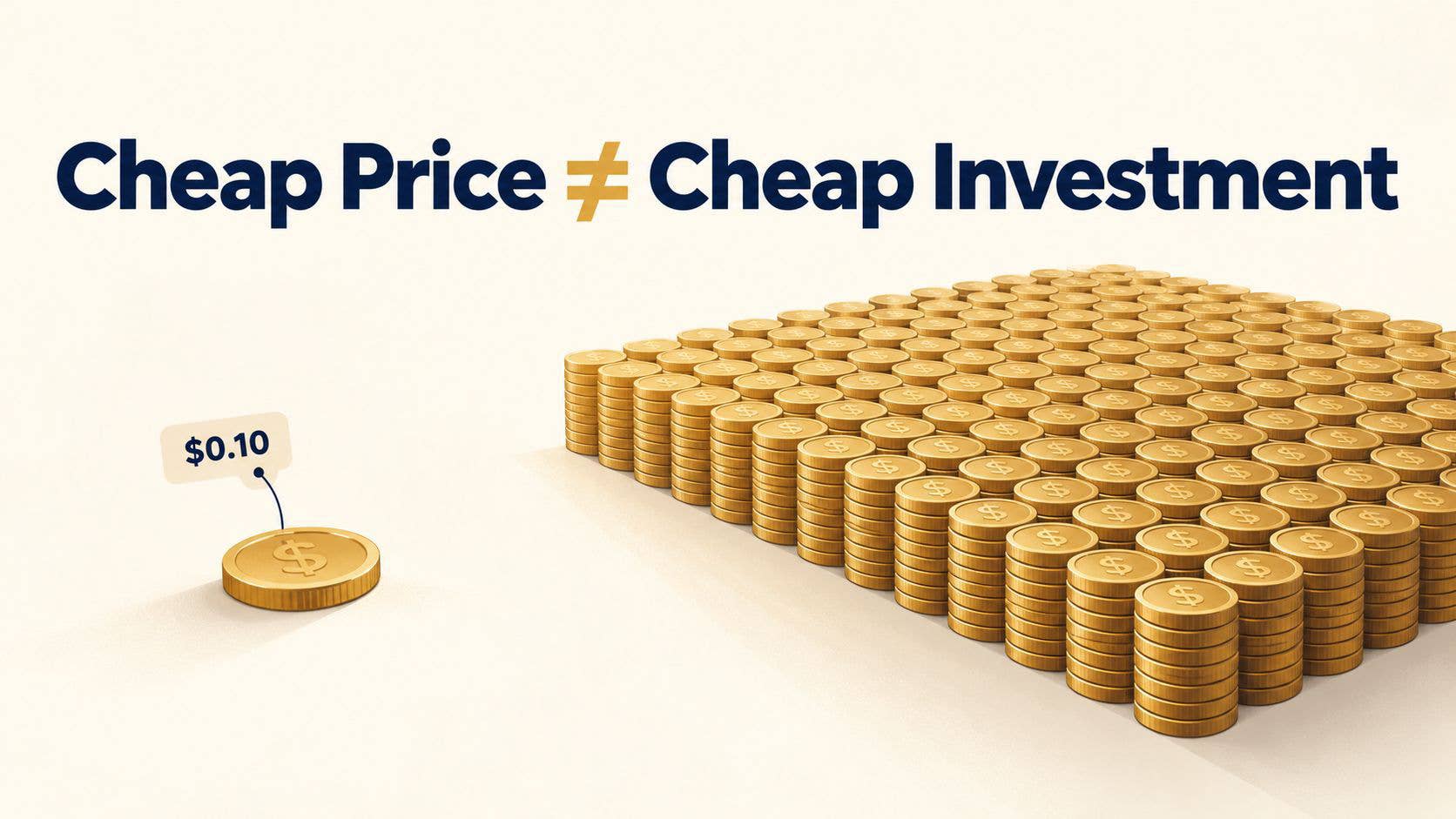
Imagine a token selling for just $0.10. If 20 billion tokens are circulating, its market capitalisation is $2 billion. Calling it “cheap” because it costs ten cents would ignore the size of the supply.
Market capitalisation is a useful starting point, but it does not tell us what an asset ought to be worth. For a company, I would also want to examine its revenue, profits, cash flow, debt, growth prospects and the price investors are being asked to pay relative to those figures. For a token, I would ask what it is used for, whether people actually need it, how supply changes, and whether there is enough trading activity for holders to sell.
What has not entered the market yet?
With a new token, I look beyond circulating supply to its fully diluted valuation, commonly called FDV:
FDV = current token price × total or maximum token supply used in the calculation
Suppose only one billion tokens are circulating at $1 each, while the project has a maximum supply of ten billion. Its current market capitalisation is $1 billion, but its FDV, using that maximum supply, is $10 billion.
Does that mean all ten billion tokens will arrive tomorrow? No. It means I need to find out when and how the remaining tokens could enter circulation. I also need to check whether the stated supply can change. FDV is a way to ask a better question; it is not a prediction of a future market capitalisation.
This matters especially when a project launches with a small fraction of its tokens available for trading. A limited initial supply can help support a striking early price. Later, tokens allocated to founders, investors, contributors or the community may become available. The price does not have to fall when that happens: demand may grow too. But I would want to know the release schedule before assuming the launch price can last.
Stocks have a related issue. Before buying into an IPO, I would check how many shares exist, how many are being offered to the public, and whether the company is issuing new shares or existing owners are selling theirs. I would also check for options, convertible securities and any arrangements that could increase the number of shares later. The price of one share makes more sense once I know what fraction of the business it represents.
Who owns most of it?
Another question I take seriously is ownership. In crypto, people often call large holders whales. In stocks, we may be looking at founders, early investors, institutions or other major shareholders.
I want to know how much they hold and when they are allowed to sell. Are their holdings locked for a period? Are they released gradually through vesting? Are they already free to trade? A token unlock or the expiry of an IPO lockup does not guarantee a sell-off. It does mean that people who could not previously sell may now have the option.
Concentrated ownership raises another question: whose incentives are shaping the market? An early investor who acquired an asset at a tiny fraction of today’s price may be happy to sell at a price a new buyer considers a bargain. Both are looking at the same chart, but they are making decisions from very different positions.
And even if the headline price looks attractive, can you buy or sell a meaningful amount at that price? In a thin market, the price displayed on a screen may apply to only a small trade. Larger orders can move the price considerably. That is why I also pay attention to trading volume and liquidity, especially around a new listing.
The questions I ask before I buy
When excitement around a new asset becomes loud, I try to slow down and ask:
What exactly am I buying, and what rights or uses come with it?
How many shares or tokens exist, and how many can trade today?
Will more enter the market? If so, when and under what conditions?
Who are the largest holders, and what did they pay?
What does the price imply for the value of the whole company or token supply?
What evidence supports that value beyond a story about where the price might go?
A convincing answer does not guarantee a profit. Markets can surprise even careful investors. But asking these questions can keep me from confusing a small unit price with a good deal.
That was the idea behind my WhatsApp video. People can agree among themselves that an asset should be worth a fortune. They can even find someone willing to pay a remarkable price for it before a proper market exists. Eventually, though, buyers and sellers meet in a market with real supply, real demand and real money at stake.
Before I ask, “How high can this go?”, I would rather ask, “What am I paying for, how much of it exists, and who might be ready to sell it to me?”
📖 ALSO READ: Dangote Refinery IPO: A Fundamental Analysis of the ₦525 Offer Price
📖 ALSO READ: The Art of Business Optimization: Why 'Good Enough' Is Not Enough
📖 ALSO READ: From Snake to Startups: Why We Shouldn't Lock Students Out of Social Media and Chatbots