
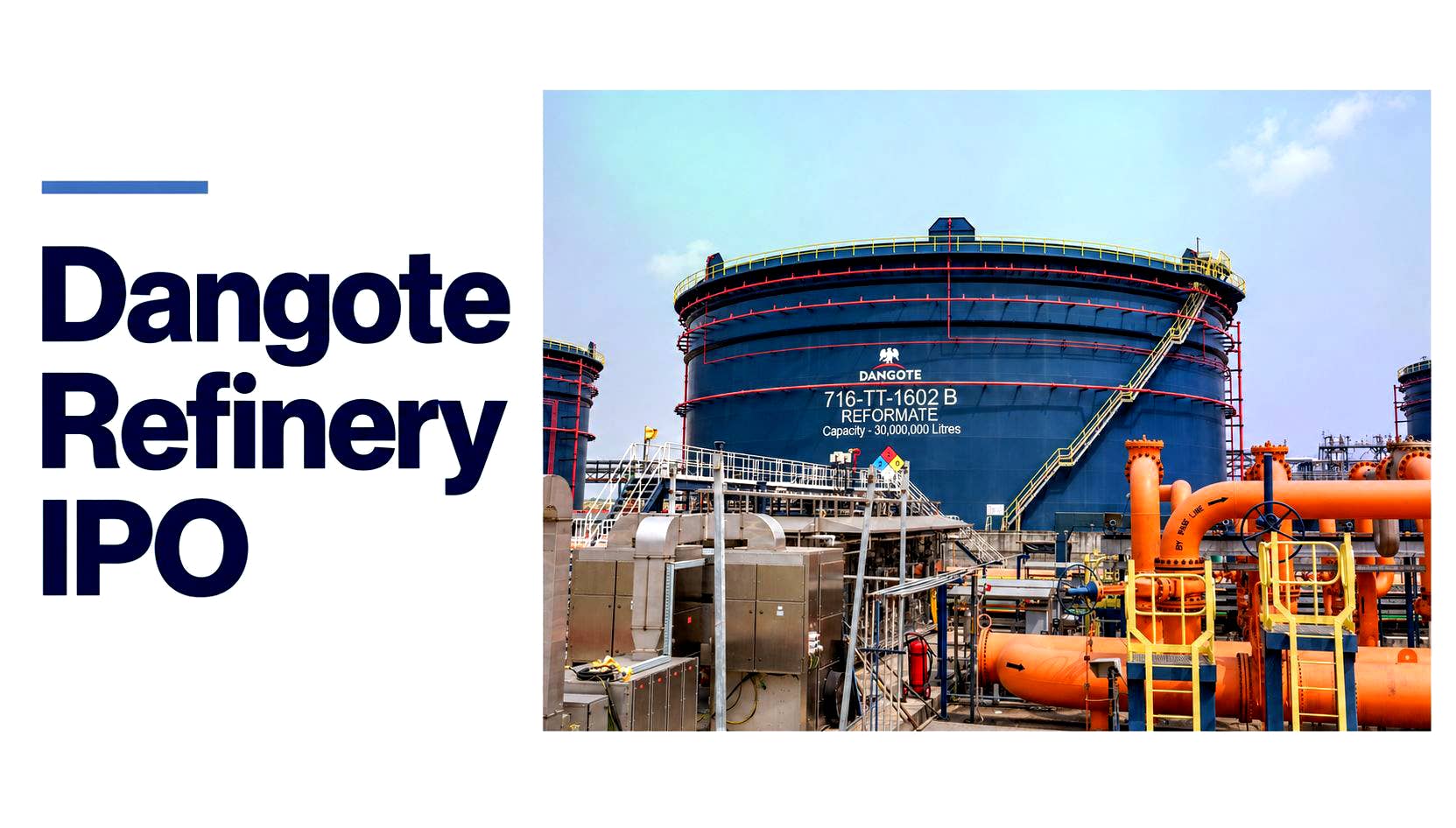
Dangote Petroleum Refinery and Petrochemicals is no longer merely one of Africa’s most ambitious industrial projects. With its initial public offering now open, it is also becoming one of the most consequential investment tests in the history of Nigeria’s capital market.
The public offer opened on 14 September 2026 and is scheduled to close on 13 October 2026. The company is issuing 4.1 billion new ordinary shares at ₦525 each, with a minimum subscription of 10 shares, or ₦5,250. If fully subscribed, the base offer will raise approximately ₦2.15 trillion. Trading is expected to begin on the Nigerian Exchange in November, subject to allotment and final listing procedures. Nigeria’s Securities and Exchange Commission has advised investors to use only authorised subscription channels and to read the approved prospectus carefully.[1][2]
The refinery is a powerful business with strategic importance, expanding international reach and rapidly improving earnings. However, a great asset is not automatically a great investment at every price. The central question is therefore not whether Dangote Refinery is important, but whether ₦525 per share gives investors an adequate margin of safety.
What Does the ₦525 Price Value the Company At?
Before the offer, the refinery had approximately 120.13 billion shares in issue. At ₦525 per share, the implied pre-offer equity valuation is:
120.13 billion shares × ₦525 ≈ ₦63.07 trillion.
Because this is a primary offer, the company is creating new shares and will receive the proceeds. Existing shareholders are not selling the 4.1 billion base-offer shares. If the offer is fully subscribed, the total number of shares will rise to approximately 124.23 billion. The corresponding post-money market capitalisation is:
124.23 billion shares × ₦525 ≈ ₦65.22 trillion.
The new investors would collectively own approximately:
(4.1 billion ÷ 124.23 billion) × 100% ≈ 3.30%.
This explains why the offer is sometimes described as a 3% sale and elsewhere as a 3.3% sale. The former is a rounded description; 3.30% is the calculated interest in the enlarged company under the base offer. The transaction also contains an over-allotment provision that may permit additional shares to be issued if demand is strong and the necessary approval is obtained.[2][3]
The refinery reportedly cost about $20 billion to build, whereas the base IPO price implies a post-offer equity value close to $49 billion. Construction cost and business value are not identical: a productive asset can become worth considerably more than the amount spent building it. Nevertheless, this difference indicates that investors are already paying for substantial future growth and profitability.
What Do the Earnings Say?
For the first half of 2026, the refinery reported revenue above $13 billion and profit after tax of $1.82 billion. This was a sharp turnaround from the loss recorded in 2025. Secured debt had also fallen to approximately $5.67 billion by the end of June 2026.[4][5]
Using the prospectus figures reported in naira—approximately ₦19.13 trillion in first-half revenue and ₦2.50 trillion in profit after tax—a basic annualisation gives the following estimates:
- Estimated annual revenue: ₦19.13 trillion × 2 = ₦38.26 trillion.
- Estimated annual profit: ₦2.50 trillion × 2 = ₦5.00 trillion.
- Implied price-to-sales ratio: ₦65.22 trillion ÷ ₦38.26 trillion ≈ 1.70.
- Implied price-to-earnings ratio: ₦65.22 trillion ÷ ₦5.00 trillion ≈ 13.0.
- Annualised net margin: ₦5.00 trillion ÷ ₦38.26 trillion ≈ 13.1%.
An annualised price-to-earnings ratio near 13 may appear moderate for a large, export-oriented business with expansion potential. The weakness in this calculation is that it doubles the result of one unusually profitable six-month period. Refining is cyclical. Profitability depends on crude-oil costs, selling prices for refined products, plant utilisation, maintenance shutdowns, freight, financing costs, exchange rates and the crack spread—the difference between the cost of crude oil and the value of the products refined from it.
The first half of 2026 benefited from serious disruptions in global fuel supply. During the second quarter, Dangote exported about 80,000 barrels per day of jet fuel to Europe and became the continent’s largest external supplier after the United States. This demonstrates the refinery’s commercial strength, but it also means that investors should not automatically treat exceptional margins as permanent.[4]
Reuters Breakingviews estimated the offer at about 8.3 times projected 2026 EBITDA, above the multiples of established United States refiners such as Valero and Phillips 66. The premium suggests that the offer price already reflects the refinery’s scarcity, scale, location, regional importance and proposed expansion.[6]
Who Owns the Refinery?
The published ownership information shows that Aliko Dangote’s beneficial interest is distributed across several corporate vehicles:
- Dangote Oil Refining Company Limited: approximately 79.09 billion shares.
- Dangote Industries Limited: approximately 17.90 billion shares.
- Greenview International Corporation: approximately 7.80 billion shares.
- Salamad Ventures Limited: Dangote holds a 60% beneficial interest in this company.Its exact refinery shareholding is not separately stated in the cited report.
These interests together amount to approximately 104.83 billion shares, representing 87.27% of the 120.13 billion shares outstanding before the public offer. If the base offer is fully subscribed, dilution would reduce this beneficial interest to approximately 84.39%.
- NNPC Limited: Also,it is reported that NNPC holds 6.815% before the IPO, equivalent to approximately 8.19 billion shares using the rounded total. Its percentage would dilute to approximately 6.59% after full subscription to the base offer.
The Private Placement Before the IPO
Before the public offer, the refinery completed a reported $2.5 billion private placement at an estimated $40 billion valuation. The round attracted institutional capital, with Africa Finance Corporation reported among the investors. The Financial Times also reported backing from African Export-Import Bank and stated that demand was substantially greater than the amount offered.[7][8]
If the entire $2.5 billion represented new equity and the reported $40 billion figure was a post-money valuation, the implied percentage sold would be:
($2.5 billion ÷ $40 billion) × 100% = 6.25%.
This 6.25% is an estimate rather than a disclosed ownership figure. The actual percentage depends on whether the $40 billion figure was calculated before or after the investment, the type and number of securities issued and any other transaction adjustments.
Dangote Industries separately announced a $1 billion underwriting programme in August 2026. It comprised a completed $600 million private placement funded by Pan-African Refinery Investment SPV, a subsidiary of Lilium Capital Group, and a further $400 million underwriting commitment. Marob Strategies and Lilium Capital structured the programme and said they were engaging sovereign wealth funds, governments and institutional investors. The announcement did not publish a complete final list of participating investors or the precise ownership received by each institution.[9]
The IPO’s approximate $49 billion post-money value is about 22.5% above the reported $40 billion private-round valuation:
[($49 billion − $40 billion) ÷ $40 billion] × 100% = 22.5%.
Public investors are therefore entering at a higher implied valuation than investors in the earlier private round. The premium may reflect improved earnings, debt reduction, greater liquidity and the benefits of a public listing. Even so, it is a premium that prospective investors should evaluate carefully.
How Earlier Dangote Listings Performed
Dangote Cement and Dangote Sugar offer useful historical context, although neither company can predict how the refinery will perform. Their histories show that successful industrial businesses can create considerable long-term value while still subjecting shareholders to deep declines and lengthy periods of weak price performance.
Dangote Sugar Refinery
Dangote Sugar was listed on 8 March 2007 at ₦18 per share. By 16 September 2026, its market price was approximately ₦70.45. This represents a nominal price increase of about 291% and an annualised price return of roughly 7.2%, excluding dividends and bonus shares.[10]
The path was far from smooth. The share price ended 2008 below its offer price and declined to approximately ₦5.78 in 2012—around 68% below the original entry price. Ten years after listing, the stock was only modestly above ₦18. Most of its major rerating occurred much later.
Dangote Cement
Dangote Cement joined the market by introduction on 26 October 2010 at ₦135 per share following its merger with Benue Cement Company. By 16 September 2026, the price had reached approximately ₦1,034. That amounts to a nominal price gain of about 666% and an annualised price return near 13.7%, excluding dividends.[10]
Again, the headline return hides a long wait. The stock traded around ₦100 by the end of 2011 and was approximately ₦152 in October 2020, almost ten years after admission. The stronger rerating arrived later as earnings expanded. The company also developed a substantial dividend record: its audited 2024 report recorded group profit after tax of approximately ₦503 billion and a proposed dividend of ₦30 per share.[11]
These examples provide an important warning. A respected brand, dominant market position and profitable operations do not guarantee immediate share-price appreciation. Nominal naira returns should also be considered alongside dividends, inflation and exchange-rate depreciation, particularly for anyone measuring wealth in real or foreign-currency terms.
Dangote Refinery Compared With Major Global Refineries
Capacity alone does not determine the economic value of a refinery. Utilisation, complexity, available crude grades, operating costs, product mix, port access, distribution networks and the markets served are equally important. Nevertheless, capacity provides a useful starting point.
| Refinery or complex | Approximate capacity | Business reach and distinguishing feature |
|---|---|---|
| Dangote Refinery, Nigeria | 700,000 barrels per day | Africa’s largest single-train refinery. It supplies Nigeria and other African markets and has become an important exporter of diesel, gasoil and aviation fuel to Europe. |
| Jamnagar complex, India | About 1.4 million barrels per day | The world’s largest refining complex, consisting of two major refineries with extensive domestic and international distribution. |
| Motiva Port Arthur, United States | About 626,000 barrels per day | One of the largest refineries in the United States, positioned within the mature North American fuel and logistics market. |
Jamnagar’s combined capacity is about twice Dangote’s current capacity. Dangote’s proposed $14.3 billion expansion would increase capacity to approximately 1.4 million barrels per day by 2029 or 2030, placing it in the same capacity class as Jamnagar. Investors should, however, distinguish between a facility that is already operating and capacity that still has to be financed, constructed, commissioned and operated successfully.[4][6][12][13]
Dangote’s location is a major commercial advantage. It is close to Africa’s largest domestic fuel market, has direct access to Atlantic shipping routes and can serve West African economies that have historically relied heavily on imported refined products. It can reportedly process 36 crude grades, giving it useful feedstock flexibility. Its 2026 exports to Europe also demonstrate that its addressable market extends beyond Africa.[4][6]
Unlike large listed refiners that operate several plants, Dangote remains heavily concentrated in one location. A prolonged outage, crude-supply interruption, regulatory dispute or logistics problem at the Lekki complex could therefore have a disproportionately large effect on the company’s earnings.
Why ₦525 Could Be a Good Entry Price
- Strategic scale and scarcity: There is no comparable publicly traded African refinery of this size. The company occupies an important position in Nigerian and regional energy supply.
- Strong present earnings: The $1.82 billion first-half profit demonstrates the amount of cash the refinery can generate when utilisation and global refining margins are favourable.
- Import substitution and export earnings: Domestic sales can replace imported fuel, while exports generate foreign-currency-linked revenue. This provides a degree of protection against naira depreciation, although it does not eliminate Nigerian regulatory or currency risk.
- Location and logistics: Proximity to West African demand and access to marine distribution can support both domestic supply and international exports.
- Expansion potential: A successful increase to 1.4 million barrels per day, together with additional petrochemical output, could materially expand future earnings.
- Accessible minimum subscription: The ₦5,250 minimum allows many retail investors to participate, although a low minimum amount does not mean that the company’s valuation is low.
- Scarcity after listing: New investors would hold only about 3.3% under the base offer. Strong demand and a limited public float could support the initial market price, although the same conditions may reduce liquidity and amplify volatility.
Why ₦525 May Not Be a Good Enough Price
- The valuation assumes substantial success: The post-offer value is more than twice the approximate construction cost and above the valuation reported for the recent private placement.
- Premium to established refiners: The estimated 8.3-times projected EBITDA multiple is higher than those of several listed international refiners.
- Cyclical earnings: The estimated price-to-earnings (P/E) ratio of 13 relies on annualising a half-year that benefited from unusual global supply conditions. Normalised earnings may be lower.
- Expansion and financing risk: A $14.3 billion project can experience delays, cost overruns, greater borrowing requirements or further equity dilution.
- Policy and feedstock risk: Crude availability, domestic pricing arrangements, taxes, fuel regulation and exchange controls can affect profitability.
- Concentrated control: Dangote’s beneficial interest would remain approximately 84.39% after the base offer, leaving minority shareholders dependent on good governance and transparent disclosure.
- Single-site exposure: A major disruption at the Lekki facility could affect a large proportion of production and earnings.
- Inflation and currency risk: A nominal increase in the naira share price may still produce a weak real return after inflation or a loss when measured in dollars.
- IPO excitement can distort price discovery: Heavy demand may lift the price initially, but earlier Dangote-related listings show that prominent companies can remain below or only slightly above their entry prices for years.
A Practical Way to Judge the Offer
Instead of asking only whether Dangote Refinery is a good company, a prospective investor should consider four more precise questions:
- What level of annual profit can the refinery sustain across a normal refining cycle?
- How much additional debt or equity will be required to complete the proposed expansion?
- What dividend policy will balance distributions to shareholders against future capital expenditure?
- Does the expected return adequately compensate for cyclicality, Nigerian policy risk, operational concentration and minority ownership?
The following sensitivity analysis shows how much the valuation depends on sustainable earnings:
| Sustainable annual profit | Implied P/E at ₦525 |
|---|---|
| ₦5.0 trillion | 13.0× |
| ₦4.0 trillion | 16.3× |
| ₦3.0 trillion | 21.7× |
| ₦2.0 trillion | 32.6× |
This sensitivity analysis shows how the valuation changes under different assumptions about sustainable annual profit, while holding the ₦525 offer price and the implied post-offer market capitalisation of approximately ₦65.22 trillion constant. The price-to-earnings (P/E) ratio is calculated by dividing market capitalisation by annual profit.
If the refinery sustains annual profit of ₦5 trillion, its implied P/E is approximately 13 times, meaning investors are paying ₦13 for every ₦1 of annual earnings. If profit falls to ₦2 trillion, the ratio rises to approximately 32.6 times, making the same offer price more expensive relative to earnings.
These profit levels are illustrative scenarios, not forecasts. The table highlights why the investment case depends on the refinery’s ability to sustain earnings across favourable and difficult operating conditions. A P/E ratio does not indicate a guaranteed investment recovery period, since earnings can change and may not be distributed entirely as dividends.
Conclusion
Dangote Refinery is a rare African industrial asset: large, strategically located, export-capable and increasingly important to international fuel markets. Its first-half 2026 performance demonstrates considerable earnings potential, while its proposed expansion could place it among the world’s largest refining complexes.
The IPO is not obviously cheap. The ₦525 offer price implies a pre-offer value of approximately ₦63.07 trillion and a post-money value of about ₦65.22 trillion under the base offer. It also represents a meaningful premium to the valuation reported for the recent private round and a higher operating multiple than several established global refiners. Investors may already be paying for high utilisation, strong refining margins, successful expansion and disciplined execution.
For a long-term investor who believes in African fuel demand, the refinery’s export potential and Dangote’s ability to execute large industrial projects, ₦525 may be a reasonable entry into a scarce strategic asset. For an investor seeking a wide margin of safety, the valuation may be too demanding until the company establishes a longer public record of through-cycle earnings, dividends and corporate governance.
The balanced conclusion is therefore neither an automatic “buy” nor an automatic “avoid.” Dangote Refinery may be an exceptional business offered at a price that already carries high expectations. Investment horizon, portfolio size and tolerance for volatility are as important as confidence in the refinery itself.
Disclaimer: This article is provided solely for educational and informational purposes. It does not constitute investment, financial, legal or tax advice and is not a recommendation to buy, sell or hold any security. IPO investments can be volatile and may result in partial or total loss of capital. Prospective investors should read the official prospectus, verify current information through approved regulatory and market channels, assess their personal circumstances and, where necessary, consult a licensed investment adviser.
Sources and Further Reading
- Securities and Exchange Commission Nigeria: Dangote Petroleum Refinery and Petrochemicals Initial Public Offering.
- Reuters: Facts about Nigeria’s Dangote oil refinery initial public offering.
- Reuters: Nigeria’s SEC approves Dangote Refinery IPO.
- Reuters: Dangote profits from Europe fuel crunch as IPO tests investor appetite.
- Billionaires.Africa: Refinery prospectus reveals Dangote’s beneficial ownership and NNPC stake.
- Reuters Breakingviews: Dangote puts a rich price on refining scarcity.
- Reuters: Dangote launches Africa’s largest IPO following the private placement.
- Financial Times: Dangote secures private investment to expand Lagos refinery.
- Dangote Industries: $1 billion underwriting programme and $600 million funded private placement.
- Nairametrics: How other Dangote Group companies performed after listing.
- Dangote Cement: 2024 audited annual report and financial statements.
- Reuters: Capacity of Reliance Industries’ Jamnagar refining complex.
- Reuters: Capacity of Motiva’s Port Arthur refinery.
📖 ALSO READ: The Art of Business Optimization: Why 'Good Enough' Is Not Enough
📖 ALSO READ: How NERD Might Reshape Nigeria's Education Sector
📖 ALSO READ: From Snake to Startups: Why We Shouldn't Lock Students Out of Social Media and Chatbots