
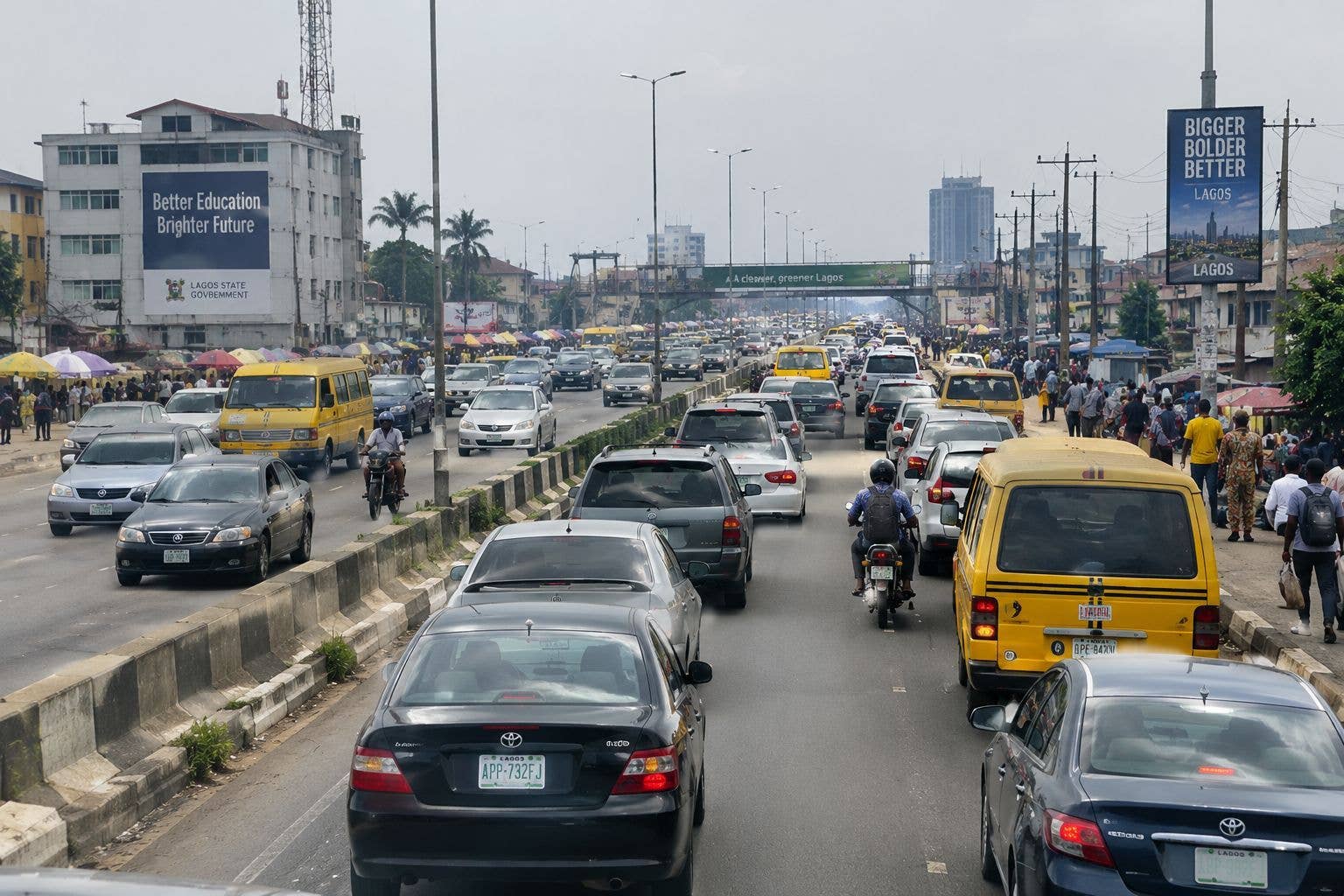
Traffic congestion is frequently interpreted as evidence that a city has outgrown its road infrastructure. The reasoning appears intuitively compelling: when the volume of vehicles exceeds the space available to accommodate them, expanding that space should restore the movement of traffic. Consequently, road widening, highway construction and junction expansion have become familiar responses to urban mobility problems. Yet the persistence of congestion following substantial infrastructure investment suggests that the relationship between road capacity and traffic performance is considerably more complex than this reasoning implies.
The difficulty lies partly in how the problem is defined. Traffic congestion is not simply a shortage of asphalt; it is an outcome of interactions between travel demand, network configuration, commuter behaviour, public transport provision and the distribution of activities across urban space. Where these relationships are inadequately understood, an intervention that improves one section of a road may yield disappointing results across the wider network. The more consequential question, therefore, is not whether additional roads can accommodate more vehicles, but under what conditions expanding road capacity produces a sustained improvement in urban mobility.
The Economics of Induced Traffic
An important explanation for the limited effectiveness of some road expansion projects is induced travel demand. When additional road capacity reduces the time or inconvenience associated with driving, previously suppressed journeys may become attractive, existing motorists may change their routes or departure times, and travellers may substitute private vehicles for alternative modes of transport. Over a longer period, improved accessibility can also influence residential choices, commercial development and the geographical distribution of employment.
These responses complicate the assumption that traffic demand remains constant after infrastructure improvements. A road is not a passive channel through which a predetermined volume of traffic flows; its accessibility and convenience influence how people choose to travel.
Duranton and Turner (2011), in their influential study of United States metropolitan areas, found a strong relationship between interstate highway capacity and vehicle travel, providing substantial evidence that additional capacity generates additional driving. Cervero (2003) similarly examined the relationship between highway investment, induced travel and urban growth. More recently, a study by Ossokina, van Ommeren and van Mourik (2023) investigated whether highway capacity expansions reduce congestion, highlighting the importance of understanding network-wide responses rather than evaluating construction projects solely by their immediate effects.
These findings should not be interpreted as proof that every road expansion is futile. Where an existing corridor is genuinely capacity-constrained, additional infrastructure may deliver substantial benefits. The relevant distinction is between increasing the capacity of a road and improving the performance of the transportation system over time. The former is a physical intervention; the latter is an outcome influenced by how travellers and urban activities respond to it.
Why the Bottleneck Matters More Than the Width of the Road
The limitations of isolated road expansion become clearer when traffic is examined as a network-flow problem. Consider a major urban road that accommodates a large volume of vehicles but terminates at an intersection with insufficient capacity. Even if the preceding carriageway is widened, the intersection may remain the principal restriction on the rate at which vehicles can leave the corridor. The improvement may therefore increase the number of vehicles arriving at the junction without proportionately increasing the number that can pass through it.
In network analysis, such a restriction is commonly understood as a bottleneck. Its significance extends beyond the immediate location because congestion can propagate backwards, affecting adjoining routes and altering journey times across the network. A road that performs efficiently in isolation may consequently contribute little to overall mobility if its connections cannot accommodate the resulting traffic flows.
This is also why adding a new route does not invariably improve a congested network. The Braess paradox, introduced by the mathematician Dietrich Braess, demonstrates theoretically that under particular conditions, adding a link to a transportation network can increase the total travel cost when individuals independently select routes according to their own interests. The result is counterintuitive, but it exposes an important distinction between individual route choice and collective network efficiency.
The paradox is not a claim that new roads generally worsen traffic. Rather, it establishes that the relationship between infrastructure provision and system performance cannot always be inferred from the characteristics of the new infrastructure alone. Route interactions, congestion costs and travellers' responses must also be considered.
For urban planners, the practical implication is that diagnosing the location and nature of a network's principal constraints should precede major investment decisions. In some circumstances, junction redesign, improved signal coordination or the removal of operational obstructions may offer greater benefits than widening an already adequate carriageway.
The Wider Transportation System
Road networks do not operate independently of public transportation or urban development. Where reliable alternatives to private vehicles are limited, improvements in driving conditions may reinforce dependence on cars and other road vehicles. Conversely, an effective public transport system can accommodate substantial passenger demand without requiring every additional journey to occupy road space through a separate private vehicle.
The relationship between these modes is particularly important because their performance can be interdependent. The Downs–Thomson paradox describes circumstances in which expanding road capacity can undermine public transport patronage, potentially affecting service frequency and the relative attractiveness of both modes. The precise outcome depends on factors such as service provision, operating arrangements and the extent to which travellers regard the alternatives as substitutes; it should not be assumed to occur in every city.
Nevertheless, the underlying policy concern is significant. If investment consistently favours private-vehicle movement while public transport remains unreliable, the city may strengthen a pattern of travel that places increasing pressure on its road network.
Land-use decisions also influence this dynamic. When housing, employment, education and commercial activities are dispersed without adequate transport connections, residents may face longer journeys and fewer practical alternatives to road travel. Infrastructure planning must therefore be coordinated with the spatial organisation of urban activities rather than treated as an entirely separate exercise.
The appropriate response is not to abandon road construction, but to assess it alongside public transport, pedestrian infrastructure, parking management and the organisation of traffic at critical junctions. The objective should be to improve access to destinations, not merely to maximise the number of vehicles that can occupy a particular road.
What Mathematical Optimisation Contributes
This problem illustrates the practical relevance of mathematical modelling and optimisation in public decision-making. When several interventions are available but financial resources, land and construction time are limited, authorities must determine which combination is most likely to produce the greatest overall benefit.
An optimisation model could, for example, seek to minimise aggregate journey delays subject to constraints involving road capacities, traffic-signal timings, construction budgets and public transport resources. Depending on the policy objective, the model might also incorporate safety, emissions, accessibility and the distribution of benefits among different groups of travellers.
The formulation of the objective is crucial. A strategy designed exclusively to increase vehicle throughput may produce a different outcome from one intended to reduce average passenger journey time or improve access for the greatest number of people. A road that carries fewer vehicles but supports efficient, high-capacity public transport may, under certain conditions, move more people than a road dominated by private cars.
Mathematical modelling enables planners to compare these alternatives systematically, test assumptions and estimate the consequences of competing interventions. However, its conclusions remain conditional on the quality of the underlying data and the realism of the model. An optimisation procedure cannot compensate for an objective that neglects important social costs or for assumptions that misrepresent how travellers behave.
Consequently, the value of mathematical analysis lies not in replacing professional judgement but in making decisions more transparent, measurable and open to evaluation. Traffic counts, journey-time observations, queue measurements and public transport data can provide the empirical foundation for such analysis, allowing proposed interventions to be assessed against actual network conditions.
Lessons for Nigerian Cities
For Nigerian cities experiencing rapid urban growth, the distinction between road construction and transportation planning is especially consequential. Expanding populations, commercial activity, changing travel patterns and competing infrastructure demands place considerable pressure on public resources. Under these circumstances, projects should be prioritised according to their demonstrated contribution to mobility rather than their physical scale or visibility.
A congested corridor may genuinely require additional capacity, whereas another may be constrained principally by poorly managed junctions, roadside obstructions, inadequate public transport or inefficient traffic control. These situations cannot be addressed effectively through an identical intervention. Reliable local data and careful diagnosis are therefore indispensable, particularly where large capital projects compete with less expensive operational improvements.
Evaluation must also continue after construction. The completion of a road demonstrates that infrastructure has been delivered; it does not, by itself, establish that travel conditions have improved sustainably. Authorities should monitor journey times, traffic volumes, safety and the performance of connecting routes, using the evidence to determine whether the intervention has achieved its intended objectives.
Such accountability would encourage a more adaptive approach to transportation policy, in which subsequent decisions are informed by observed outcomes rather than by the assumption that expanding infrastructure necessarily resolves congestion.
Conclusion
The persistent recurrence of traffic congestion demonstrates the limitations of treating urban mobility as a problem of road space alone. Although additional capacity can be indispensable, its effectiveness depends on network configuration, travel behaviour, alternative modes of transport and the distribution of urban activities. An intervention that neglects these relationships may deliver immediate relief without producing a commensurate improvement in long-term mobility.
The central challenge for transportation authorities is therefore analytical as much as infrastructural: to identify the constraints that govern network performance and select interventions that address them collectively. Systems thinking, empirical evaluation and mathematical optimisation offer valuable means of meeting this challenge, particularly where public resources must be allocated among competing needs.
Ultimately, the success of a transportation policy should be judged not by the number of roads constructed or lanes added, but by the extent to which it enables people and goods to move safely, efficiently and affordably. Building additional roads may form part of the solution; understanding the system in which those roads operate is what makes a lasting solution more attainable.
References
Braess, D. (1968). Über ein Paradoxon aus der Verkehrsplanung. Unternehmensforschung, 12, 258–268.
Cervero, R. (2003). Road expansion, urban growth, and induced travel: A path analysis. Journal of the American Planning Association, 69(2), 145–163. https://doi.org/10.1080/01944360308976303
Duranton, G., & Turner, M. A. (2011). The fundamental law of road congestion: Evidence from US cities. American Economic Review, 101(6), 2616–2652. https://doi.org/10.1257/aer.101.6.2616
Ossokina, I. V., van Ommeren, J., & van Mourik, H. (2023). Congestion in cities: Can road capacity expansions provide a solution? Transportation Research Part A: Policy and Practice, 174, 103726. https://doi.org/10.1016/j.tra.2023.103726
📖 ALSO READ: The Art of Business Optimization: Why 'Good Enough' Is Not Enough
📖 ALSO READ: A Cheap Price Does Not Mean a Cheap Investment
📖 ALSO READ: Nigeria at 66: The Independence to Build Our Technological Future