
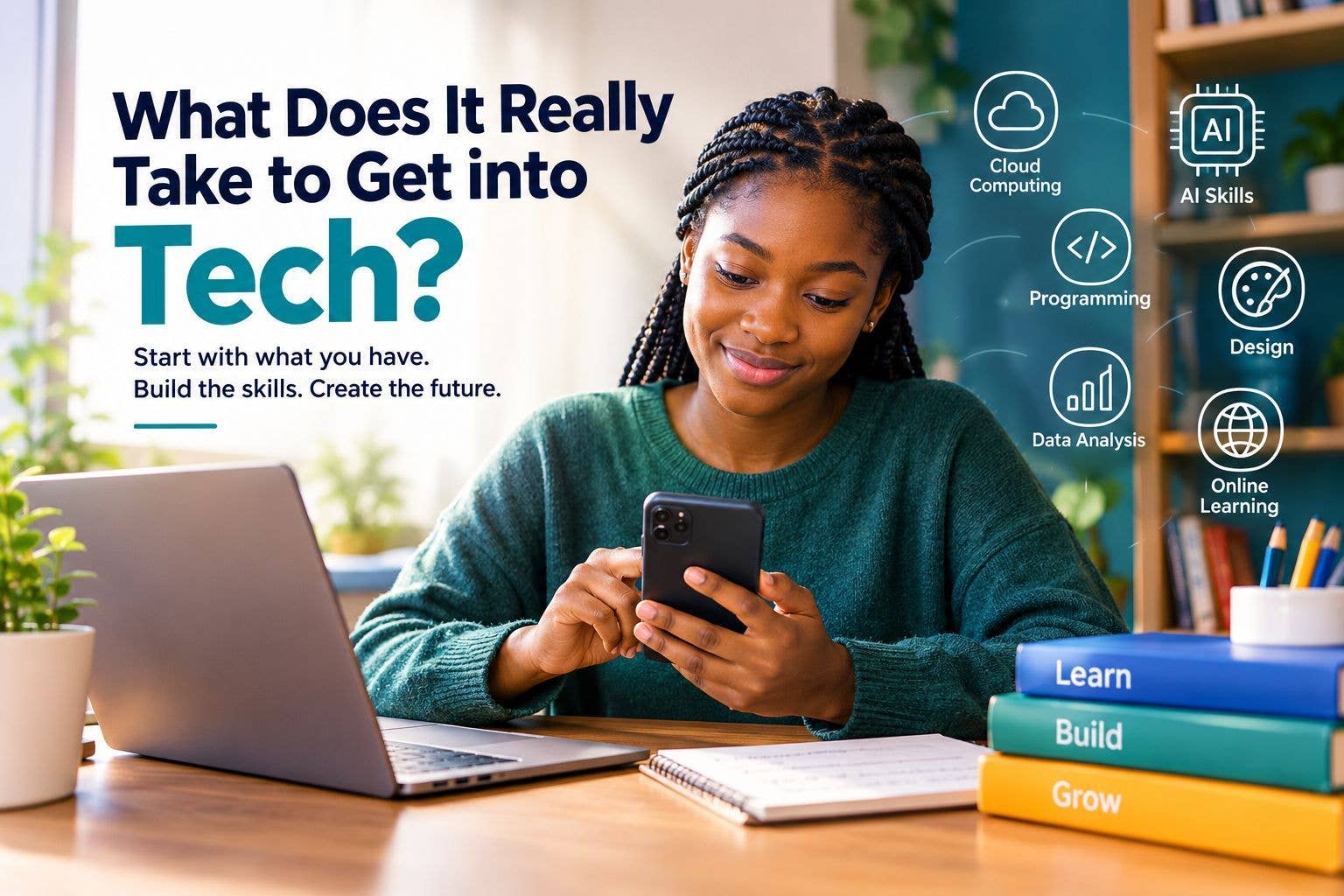
One misconception I believe is worth addressing is the tendency to imagine technology as an exclusive domain reserved for people who possess sophisticated computers, operate from well-equipped workspaces, and spend countless hours writing and debugging lines of code. While this description captures certain aspects of software development and other technically demanding occupations, it hardly represents the full breadth of an industry whose influence now extends into virtually every sphere of human activity.
Consider how much we accomplish with our smartphones today. Activities that once required the assistance of specialized professionals can now be performed, at least in their simpler forms, through readily available mobile applications, online platforms, and increasingly capable artificial intelligence tools. From creating promotional materials and editing videos to handling business transactions, carrying out research, analyzing information, and communicating with people across geographical borders, the smartphone has turned into a tool that lets ordinary people take part in the growing technological ecosystem.
In this sense, almost everyone who regularly uses a smartphone is already engaging with technology, although there remains an important distinction between being a user of technological products and possessing the expertise to develop, manage, or deploy them professionally. Grasping this difference is vital, since the aim is not simply to prove that technology is everywhere, but to recognize that being familiar with digital tools can serve as a basis for building more valuable and specialized skills.
Now, back to the original question: what does one need to get into tech if one does not have a laptop?
The answer may be closer than many people imagine. A smartphone, an internet connection where available, a willingness to learn, and access to appropriate educational resources can provide a reasonable starting point for exploring several areas of technology, particularly at the introductory stage. While the limitations of mobile devices should not be ignored, neither should their capacity to make learning more accessible to people who might otherwise postpone their ambitions indefinitely.
Someone interested in graphic design, for instance, can begin learning the principles of visual communication and experimenting with mobile-friendly design applications, gradually developing an understanding of layout, typography, colour, and the effective presentation of information. Similarly, an aspiring programmer can study programming concepts, follow practical tutorials, and experiment with suitable browser-based coding environments, even if working on a small screen is less convenient than using a conventional computer.
Cloud computing has made this possibility even more interesting. Platforms such as Google Colab allow users to write and execute Python code within a browser-based notebook environment, using computing resources hosted remotely rather than relying entirely on the processing capacity of their personal devices. For beginners interested in programming, data analysis, or machine learning, this can reduce the need for complicated installations and make certain forms of practical experimentation possible without first acquiring a powerful computer.
Of course, a smartphone cannot replace a laptop in every situation. Some technical tasks require specialized software, extensive multitasking, a more comfortable working environment, or computing resources that exceed what a mobile device can reasonably provide; nevertheless, these limitations should encourage prospective learners to plan their progression intelligently rather than conclude that they cannot begin at all.
Where the financial means are available, starting with a reasonably capable computer is undoubtedly an advantage, especially for individuals pursuing disciplines that involve substantial programming, software engineering, or computationally intensive work. However, the absence of ideal equipment should not become a permanent excuse for inaction when there are meaningful steps one can take with the resources already available.
This is particularly important for young people who aspire to build careers in technology but assume that their financial circumstances have excluded them from the opportunities available to their more privileged counterparts. The point is not to romanticize hardship or pretend that everyone enjoys equal access to digital infrastructure; rather, it is to encourage people to distinguish between genuine limitations and assumptions that unnecessarily restrict their willingness to begin.
Start with what you have, learn what you can, and improve your resources as opportunities permit.
Yet, having considered how someone might begin learning technology without a laptop, I believe we must move beyond the question of entry itself and confront a more consequential issue: how does one position oneself to earn a living from technology?
This is where the discussion becomes particularly important in the age of artificial intelligence. As AI tools become increasingly capable of assisting with programming, content creation, data processing, design, and other activities traditionally associated with technical professionals, certain tasks that once required specialized training are becoming accessible to a broader range of people. Consequently, the distinction between technical and non-technical workers is becoming less rigid in some areas, while the competition for opportunities may intensify as more people acquire the ability to perform tasks that previously demanded greater technical expertise.
This does not necessarily mean that technology professionals will become obsolete, nor should it be interpreted as a prediction that AI will eliminate the demand for specialized knowledge. Instead, it implies that the worth of some routine technical abilities may shift as the tools for carrying them out grow more widely available, pushing professionals to rethink how they build their expertise and set themselves apart in a changing marketplace.
If a person with little programming experience can now use an AI assistant to generate a basic website, for example, the ability to produce simple code may no longer be sufficient, on its own, to establish a strong competitive advantage. Greater value may lie in understanding what the website is supposed to accomplish, determining whether the generated code is reliable and secure, resolving problems that arise during implementation, and ensuring that the finished product genuinely meets the client's requirements.
The challenge, therefore, is not simply to enter technology but to remain useful as the industry evolves. In that case, how can professionals, both those just starting out and those already established position themselves to keep generating income from their Tech skills?
Continuous learning must become a professional habit.
The pace of technological development makes it increasingly difficult to rely indefinitely on knowledge acquired at a particular stage of one's career. People who stay dedicated to learning, refreshing their knowledge, and deepening their grasp of new developments are in a stronger position to adapt when familiar tools shift or new ways of working emerge.
Continuous learning, however, should not be confused with chasing every fashionable application or attempting to master every new tool that appears. It requires discernment: the ability to identify developments relevant to one's field, understand their practical implications, and determine how they can improve the quality, efficiency, or value of one's work.
Adaptability is equally indispensable.
The ability to learn and use new tools quickly can be a considerable advantage in an industry where established workflows are continually being reconsidered. A professional who understands the principles underlying their work can often adapt more effectively than someone whose competence depends entirely on familiarity with a particular application.
Artificial intelligence should therefore be approached as an opportunity to expand one's capabilities rather than merely as a threat to one's livelihood. Learning to work effectively with AI, while maintaining the judgement necessary to evaluate its outputs, can enable professionals to improve productivity, explore new possibilities, and concentrate more attention on the aspects of their work that require deeper understanding and independent reasoning.
Above all, develop the capacity to solve problems.
Technology transforms into economic value when it is applied to meet needs that matter. Whether one is developing software, analyzing data, designing websites, or using AI to automate routine activities, the ability to identify a problem and produce a reliable solution is often more consequential than familiarity with a long list of tools.
This is why aspiring professionals should endeavour to apply what they learn through practical projects, experiments, and real-world challenges, gradually building a portfolio that demonstrates their competence. A collection of meaningful projects can communicate more about a person's capabilities than certificates alone, particularly when the individual can explain the problem addressed, the decisions made, and the results achieved.
It is equally important to develop communication skills and professional reliability, because technical ability does not automatically translate into commercial success. Clients and employers need people who can understand instructions, manage expectations, explain their decisions, and deliver dependable results; in many circumstances, the combination of technical competence and professional conduct is what transforms a one-time engagement into a lasting opportunity.
Ultimately, entering technology and earning from it are two different undertakings, even though the former may provide the foundation for the latter. Getting started requires a willingness to learn and make productive use of available resources, whereas building a sustainable career demands continuous improvement, adaptability, practical problem-solving, and an understanding of how one's skills can create value for others.
For the young person who currently owns only a smartphone, the journey can begin with an online course, a practical experiment, or the deliberate acquisition of a foundational skill. For someone who already has a laptop and has completed several training programmes, the next step may be to develop demonstrable expertise, build useful projects, and identify opportunities to apply that knowledge. The starting points differ, but the underlying responsibility remains the same: to keep developing one's capacity to contribute meaningfully in an environment that will not remain static.
The future of technology will favour neither those who possess expensive gadgets alone nor those who accumulate certificates without developing practical competence. It will progressively benefit those who are able to merge knowledge with judgement, adjust to shifting conditions, and employ the tools at hand to address problems that truly matter.
Do not allow the absence of ideal resources to prevent you from beginning, but do not mistake beginning for the completion of the journey. Start where you are, develop your skills deliberately, and prepare yourself not merely to enter the technology industry, but to remain relevant and create value within it.
📖 ALSO READ: Nigeria at 66: The Independence to Build Our Technological Future
📖 ALSO READ: From Snake to Startups: Why We Shouldn't Lock Students Out of Social Media and Chatbots