Let's be real for a moment.
If I told you there are no jobs in the Nigerian oil sector, you'd probably laugh and call me a liar. And you'd be right. The jobs are still there. But let's sit on the real question, the one that keeps many of us up at night: who is getting them?
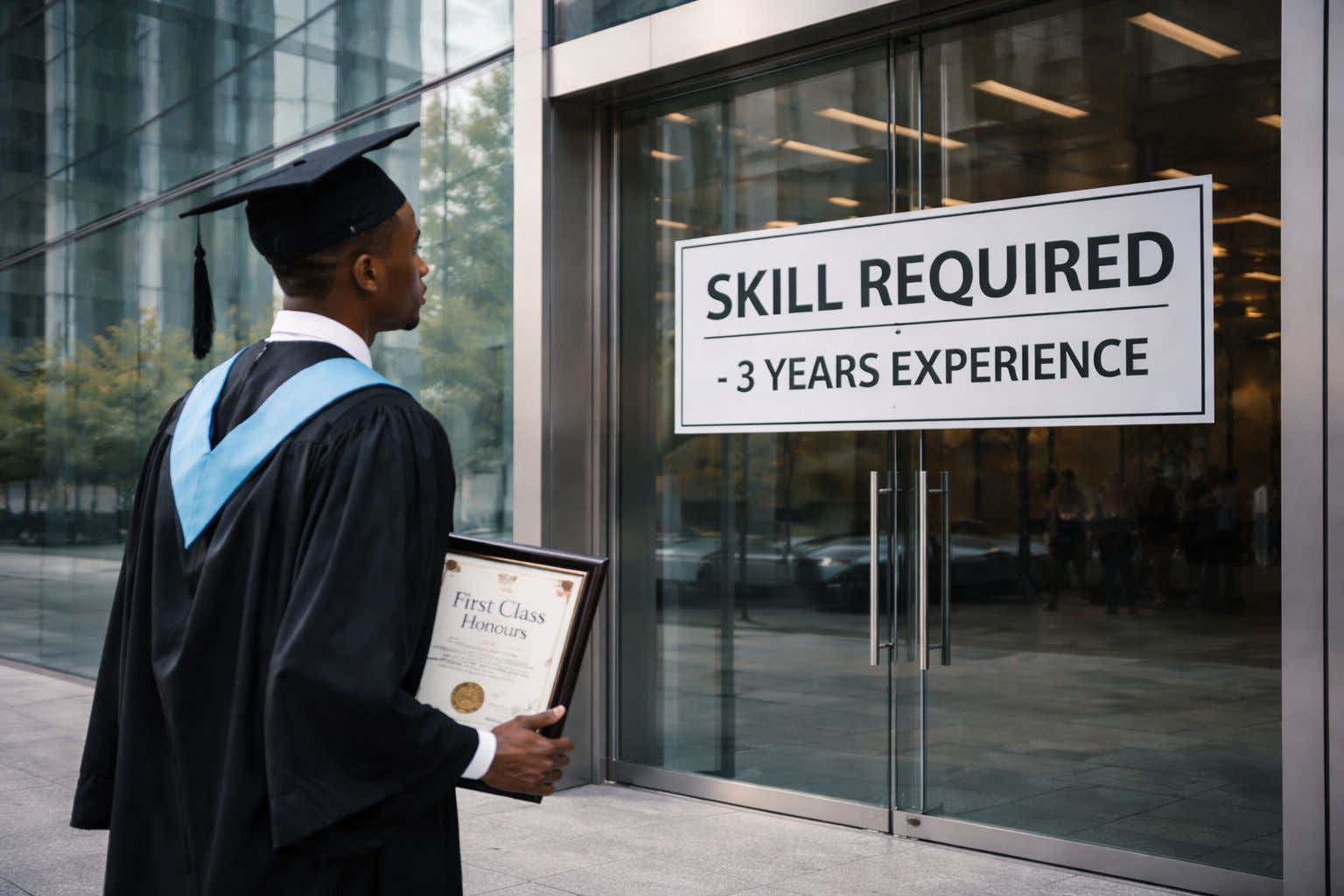
It's not like we are lacking qualified people. Walk through any Nigerian university town—Nsukka, Benin, Zaria, Ile-Ife, Abraka—and you'll see them. The graduates. Every single year, our system celebrates a record number of First Class and Second Class Upper honourees. We take pictures, we post them on Instagram, the parents dance with joy, and the uncles give long speeches about how "education is the key."
But then what?
The key is placed in the lock, and the door doesn't open. The phone doesn't ring. The applications get ignored. And that brilliant graduate, the one with the glossy certificate and the 4.5 GPA, is sitting at home wondering, "What did I do wrong?"
If this hits close to home, keep reading. Because this isn't a post about job scarcity. It's about a trap. A trap many of us have fallen into because we are playing by the rules of a game that changed years ago.
The Reality Our Parents Didn't Prepare Us For
Remember the stories? For our fathers and mothers, the path was clear. It was almost linear. Go to school, get your certificate, and walk into a job that would buy a car, build a house, and send your children to the same school. The certificate was a magic wand. It was a ticket to the "better life."
And because they loved us, they told us to follow the same path. "Just focus on your studies," they said. "Just get your paper."
But here is the painful truth they couldn't see coming: the market is now flooded with First Class graduates.
When everyone is excellent, excellence itself stops being special. It becomes the minimum requirement. The certificate that was once a golden ticket is now just an entry slip. It gets you through the gate, but it doesn't get you a seat at the table.
The Machines Are Here, and They Want Your Job
The world has moved on. It is transitioning into automation, and honestly, it doesn't care about our feelings or our family histories.
Employers today, whether in the oil and gas companies in Lagos or the banks in Abuja, are looking at a graduate and asking a different set of questions. They aren't just asking, "Did you pass your exams?" They are asking, "What can you do?" and "How will you help us grow?"
They want skills. Specifically, they want skills that deal with the automation of systems. They want people who can manage the machines, analyze the data, and leverage the software that is slowly replacing the old ways of doing things.
This isn't a prophecy of doom; it's a wake-up call.
A General's Advice on Looking Beyond the Oil
At the maiden convocation lecture of Southern Delta University, Ozoro, General Alexander O. Ogomudia (Rtd.), in his lecture, told the students something that made many of them shift uncomfortably in their seats. He spoke about the digital revolution. He explained how Artificial Intelligence isn't a sci-fi movie—it's here, automating routine tasks and helping make complex decisions.
And then he said something that should echo in the ears of every Nigerian student and parent: We need to look beyond crude oil.
For decades, we have been brainwashed to believe that the only wealth is in the ground. That the only security is in the government or the big oil companies. The General was telling them to look elsewhere. He told them to look at digital skills.
He was telling them to start drilling in a new field. Because the old wells are drying up, and the new ones are digital.
Your Personal Oil Well
Here is the good news, the part that should give you hope.
You don't need political connections to get this new oil. You don't need a "man on the inside." You don't need to pay a bribe.
Digital skills are the new global oil wells. They are the resource that can make you valuable to industries anywhere in the world. They are what turns a "job seeker" into a "problem solver."
- Learn digital marketing, and you can help a business find customers.
- Learn data analysis, and you can help an oil company predict equipment failure.
- Learn coding, and you can build the app that solves the next big Nigerian problem.
This does two things for you:
1. It makes you employable. It puts you ahead of the other thousand First Class graduates who only have their certificate to show.
2. It makes you self-employed. You can work from your bedroom in Port Harcourt and serve a client in Canada. You are no longer waiting for the government or the oil companies to "provide jobs." You are providing for yourself.
The Bottom Line
Look, I know the frustration. I know the feeling of doing everything you were told to do and still coming up short. But the world has changed, and we have to change with it.
Paper results are no longer enough. Your degree is your foundation, but the skills you build on top of it are your house. Don't let your certificate become just a framed memory on the wall.
Let's start digging for the new oil. The well is open, and it's waiting for you.
📖 ALSO READ: Automation Is Coming - Are We Ready?
📖 ALSO READ: The Hidden Mental Toll of Using AI for Complex Projects: A Personal Experience?
This blog will be shared on my LinkedIn feed, and all engagements are welcome.