
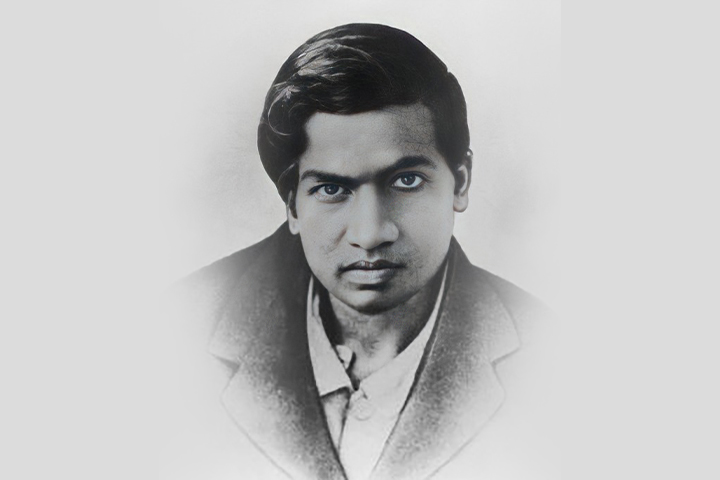
In the annals of scientific history, there are geniuses, and then there is Srinivasa Ramanujan. Born in poverty in colonial India, armed with little more than a slate and an unshakable intuition, this self-taught mathematician conjured formulas from the ether—theorems that would take the brightest minds of Europe years to prove. His life was a brief, blazing comet across the mathematical sky, and more than a century after his death, scientists are still deciphering the notebooks he left behind.
This is the story of the man who saw infinity.
A Mind Apart: The Making of a Prodigy (1887-1910)
Srinivasa Ramanujan Aiyangar was born on December 22, 1887, in the small town of Erode in Tamil Nadu, South India. His father, K. Srinivasa Aiyangar, worked as a clerk in a sari shop, earning a modest wage, while his mother, Komalatammal, was a homemaker who also sang at the local temple. It was a humble, orthodox Brahmin household—the last place one might expect to find a revolutionary mathematician.
Ramanujan's genius announced itself quietly but unmistakably. By the age of 11, he had already exhausted the mathematical knowledge of the college students who lodged at his home to support his family. He was consuming advanced trigonometry and geometry with the same ease that other children read storybooks.
The turning point came when he was 16. Ramanujan stumbled upon a book that would define his destiny: A Synopsis of Elementary Results in Pure and Applied Mathematics by G.S. Carr. This was not a traditional textbook; it was a compilation of roughly 5,000 theorems, presented with little explanation or proof. For most students, it would have been impenetrable. For Ramanujan, it was a revelation. He treated the book as a challenge, verifying each result and, in the process, developing his own unique mathematical language.
His devotion to mathematics, however, came at a terrible cost. He developed a "single-minded" obsession, neglecting every other subject. As a result, he failed his examinations at Government Arts College and later at Pachaiyappa's College—twice. To his family and community, he appeared to be a brilliant young man throwing his life away on useless numbers.
Between 1904 and 1910, Ramanujan lived in extreme poverty, often on the verge of starvation. To save money, he would walk miles to town. He filled notebooks with his findings—original research conducted in isolation, with no formal training and no access to contemporary mathematical journals. In 1909, he married a ten-year-old girl named Janakiammal, in accordance with the customs of the time. She would remain with his parents for several years before joining him, a separation that added to his personal struggles.
The Struggle for Recognition: From Clerk to Cambridge (1910-1914)
For years, Ramanujan's genius went unnoticed by the academic establishment. He mailed letters and packets of his theorems to every mathematician in India he could find, but most were either confused or indifferent.
Finally, in 1910, he caught a break. Ramaswamy Aiyer, a founder of the Indian Mathematical Society, was initially skeptical of Ramanujan's work. But after consulting with colleagues, he recognized the raw brilliance in the young man's results. Aiyer supported him, and Ramanujan secured a low-level clerical position at the Madras Port Trust. It was hardly a prestigious job, but it paid enough to keep him from starving and allowed him to continue his mathematical work in his spare time.
His colleagues and superiors at the port, including the sympathetic manager S. Narayana Iyer, encouraged him to seek recognition abroad. They understood that the mathematical establishment in India was simply not equipped to evaluate him.
Thus, in 1913, Ramanujan took a step that would change his life—and the history of mathematics. He wrote a letter to three prominent Cambridge mathematicians. The first two ignored him. The third, G.H. Hardy, almost did the same.
G.H. Hardy was one of the most rigorous and demanding mathematicians in England. When he received a thick envelope filled with theorems from an unknown clerk in Madras, his first instinct was to throw it in the trash. He assumed it was the work of a crackpot or a plagiarist.
But that night, he and his colleague J.E. Littlewood sat down to examine the manuscript. By the time they were finished, Hardy later recalled, he felt a mixture of astonishment and humility. The theorems "defeated me completely; I had never seen anything in the least like them before," he wrote. "A single look at them is enough to show that they could only be written by a mathematician of the highest class."
Some of the formulas were known but had been discovered independently by Ramanujan in ways that baffled Hardy. Others were entirely new, pointing to deep, unexplored territories in mathematics. Hardy arranged for Ramanujan to come to Cambridge immediately, despite the young man's religious objections to crossing the sea.
In 1914, Ramanujan arrived in England. The collaboration that Hardy would later call "the one romantic incident in my life" had begun.
The Hardy-Ramanujan Partnership (1914-1919)
The relationship between Hardy and Ramanujan was a study in contrasts. Hardy was an atheist, a formalist who demanded rigorous proof for every statement. Ramanujan was deeply religious, working by intuition and declaring that his equations were given to him by the goddess Namagiri in his dreams. Hardy was precise, logical, and methodical; Ramanujan was instinctive, leaping from insight to insight without stopping to fill in the steps.
Yet together, they were magnificent. Hardy taught Ramanujan the formal rigor of Western mathematics—how to construct a proof, how to connect his discoveries to the broader field of number theory. Ramanujan, in turn, poured out a seemingly endless stream of new ideas that kept Hardy and Littlewood busy for years.
One of the most famous incidents of their collaboration reveals the unique quality of Ramanujan's mind. When Hardy visited Ramanujan in the hospital, he remarked that he had taken a taxi with a rather dull number: 1729. "I hope it is not an unfavorable omen," Hardy said.
Ramanujan immediately replied, "No, Hardy, it is a very interesting number. It is the smallest number expressible as the sum of two cubes in two different ways."
(Indeed, 1³ + 12³ = 1729, and 9³ + 10³ = 1729.)
This story, often told to illustrate Ramanujan's genius, is more than just a charming anecdote. It shows that he did not merely memorize numbers; he saw them—their properties, their relationships, their hidden structures—as clearly as others see shapes and colors.
Despite having no university degree, Ramanujan's work was so exceptional that Cambridge awarded him a Bachelor of Science degree for research in 1916. His crowning achievement came in 1918, when he was elected a Fellow of the Royal Society of London—one of the highest honors in science. He was only the second Indian to receive this distinction. Shortly after, he became a Fellow of Trinity College, Cambridge, cementing his place among the intellectual elite of Europe.
The Mathematics: A Glimpse into the Infinite
Ramanujan's published work represents only a fraction of his output. During his lifetime, he produced approximately 3,900 results, filling notebooks with equations, identities, and theorems. He published 37 papers in academic journals, many in collaboration with Hardy.
His contributions span a vast range of pure mathematics, including:
- Infinite series: He produced stunning formulas for calculating pi, some of which are so efficient that they are used in modern computer algorithms.
- Number theory: He explored the properties of prime numbers, partitions, and modular forms.
- Continued fractions: He discovered identities that connected seemingly unrelated branches of mathematics.
- The partition function: His work on the number of ways a positive integer can be expressed as a sum of positive integers (a partition) led to deep insights into modular forms.
- Theta functions and mock theta functions: These concepts, introduced by Ramanujan, were so far ahead of their time that their full significance was not understood until decades later.
Perhaps most remarkably, Ramanujan's "lost notebook"—discovered in 1976 by mathematician George Andrews in a box of papers at Trinity College—contained results from the final year of his life that continue to inspire research today. In 2012, a team led by Ken Ono proved that Ramanujan's theories on mock modular forms were correct, opening up new connections to modern physics, including the study of black holes and string theory.
Final Days: A Light Extinguished (1919-1920)
Ramanujan's time in England, while intellectually fruitful, took a devastating toll on his health. The cold, damp climate, the unfamiliar food, and the wartime shortages all contributed to his physical decline. He fell seriously ill in 1917, initially diagnosed with tuberculosis—a diagnosis that was almost certainly wrong.
Modern medical researchers believe Ramanujan suffered from hepatic amoebiasis, a parasitic infection common in tropical climates that would have been treatable with modern drugs. But in 1919, the best medical care in England could not save him.
He returned to India that year, hoping that the warmth of his homeland would restore him. It did not. On April 26, 1920, at the age of 32, Srinivasa Ramanujan died.
Even in his final months, he did not stop working. His deathbed notebooks, filled with feverish scribblings of new theorems, contained what he called "mock theta functions"—mathematical objects so mysterious that they would not be fully understood for nearly a century.
Legacy: The Eternal Genius
Ramanujan once said, "An equation for me has no meaning unless it expresses a thought of God." For him, mathematics was not a human invention but a divine revelation—a language that revealed the hidden order of the universe.
Today, his legacy is more vibrant than ever. The Ramanujan Journal was founded in 1997 to publish research inspired by his work. December 22, his birthday, is celebrated as National Mathematics Day in India. His image adorns postage stamps, and his life has been the subject of books, documentaries, and the acclaimed 2015 film The Man Who Knew Infinity.
But perhaps the most fitting tribute is the ongoing work of mathematicians who continue to explore the notebooks he left behind. Each generation finds something new in Ramanujan's equations—proofs of theorems he intuited but never formally proved, connections to physics he could never have imagined, and insights that push the boundaries of human knowledge.
From a clerk in Madras to a Fellow of the Royal Society, his journey was one of triumph against impossible odds. And in the endless dance of numbers, in the elegant symmetry of his formulas, Srinivasa Ramanujan truly found infinity.
References and Further Reading:
– Encyclopaedia Britannica, 18 Dec. 2024, www.britannica.com/biography/Srinivasa-Ramanujan.
– MacTutor History of Mathematics Archive, University of St Andrews, Scotland, Sept. 1998, mathshistory.st-andrews.ac.uk/Biographies/Ramanujan/.
– The Ramanujan Institute for Advanced Study in Mathematics, University of Madras, www.unom.ac.in/ramanujan-institute/.
– Royal Society Publishing, 1918, royalsociety.org/people/srinivasa-ramanujan-12136/.
– Wikipedia, The Free Encyclopedia, 8 Feb. 2026, en.wikipedia.org/wiki/Srinivasa_Ramanujan.
– Proceedings of the London Mathematical Society, vol. 19, 1921, pp. xl-lvii.
– Current Science, vol. 79, no. 8, Indian Academy of Sciences, 25 Oct. 2000, pp. 1159-1165, www.currentscience.ac.in/
– Notices of the American Mathematical Society, vol. 67, no. 4, April 2020, pp. 514-523, www.ams.org/journals/notices/202004/rnoti-p514.pdf.